How to write a good site meeting report
12 September 2026

You’ve just come out of a site visit, your head full of observations, photos and remarks made in passing. Now comes the least fun part: writing it all up in a site report that nobody can dispute. That’s often where time slips away, and where information gets lost.
Yet the site meeting report isn’t just another administrative chore. Done well, it becomes the project’s memory, the tool that keeps everyone aligned and, if there’s a dispute, the evidence that protects you. Here’s how to write it so that it’s clear, traceable and binding, and how to make it save you time rather than cost you time.
What is a site meeting report?
The site meeting report (often simply called the site report) is the document that records what was said and decided during a site meeting: progress of the works, decisions taken, observations made, snags raised and actions to be taken. It is usually written by the project manager after each meeting, most often weekly, then sent to all parties: the client, contractors, engineering consultants and anyone else involved.
It plays three simple roles. It informs: where the site stands, who has to do what. It coordinates: it gives everyone the same level of information and synchronises the trade packages. And it records: it keeps a written, dated record of every decision and every finding, week after week.
It’s this last role that gives it its value. A site is made up of dozens of small decisions; without a record, they become memories, and memories can be disputed. The site report can’t.
Site report or handover certificate: don’t confuse the two
The two are often mixed up, wrongly. The site meeting report is a periodic monitoring document: it accompanies the works, meeting after meeting, from start to finish. The handover certificate is a one-off document that marks the end of the works: it records that the building has been handed over, with or without snags, and triggers the statutory guarantees.
In other words, the site report tells the story of the site while it is being built; the handover certificate signs it off. Both record snags, but they don’t have the same status or the same effects. Confusing the two risks weakening the legal weight of each. If in doubt, remember the rule: while the works are in progress, you write site reports; on handover day, you write a handover certificate.
Who writes the site report, and how often?
In the vast majority of cases, it’s the project manager who writes and circulates the site report, because they direct the works and chair the site meeting. They are also the one whose liability is at stake for the quality of the monitoring: a careless site report comes back first to haunt the person who wrote it.
As for frequency, site meetings are most often weekly, especially during the structural and fit-out phases. On quieter sites or during finishing works, they can be spaced out, but the principle stays the same: one meeting, one site report, sent quickly. Ideally, send the document within 24 to 48 hours of the meeting. The faster it goes out, the sooner the actions start, and the sooner any period for challenging it starts running too.
A good habit: number your site reports continuously from the start of the works (Report no. 1, no. 2 and so on). This simple numbering turns a pile of scattered documents into a real project log, where any decision can be found in seconds.
The legal framework and value of the site report
The legal value of a site report depends on the country and on the contract. The French framework is a good example of how it works.
The French example: the NF P 03-001 standard
In France, private building contracts can refer to the NF P 03-001 standard, which then serves as general administrative conditions. Among other things, it governs the project manager’s role in directing the works, the holding of site meetings and the drafting of site reports.
One point is essential: under this standard, the site report written by the project manager is deemed accepted by its recipients if it isn’t challenged in writing within a set period (usually eight days). This mechanism is what gives it all its force. A party who lets that period pass without reacting can’t later claim they disagreed.
Binding, but not a contract
The site report has no contractual value in itself: it doesn’t replace the contract, the drawings or the specifications. However, it becomes binding: if it isn’t challenged in time, its content is presumed accepted by everyone. In a dispute, it then becomes valuable evidence of the real progress of the works, the instructions given, the snags raised and each party’s commitments.
That’s exactly why rigour pays off. A vague site report, or one sent late, loses most of its value as evidence. A precise, dated site report that is always circulated protects the project manager as much as the client. Far from being a constraint, it’s an insurance policy.
The standard structure of a site report
A good site report follows the same structure from one meeting to the next. This consistency makes it easier to read, lets you find information at a glance and secures follow-up from week to week.
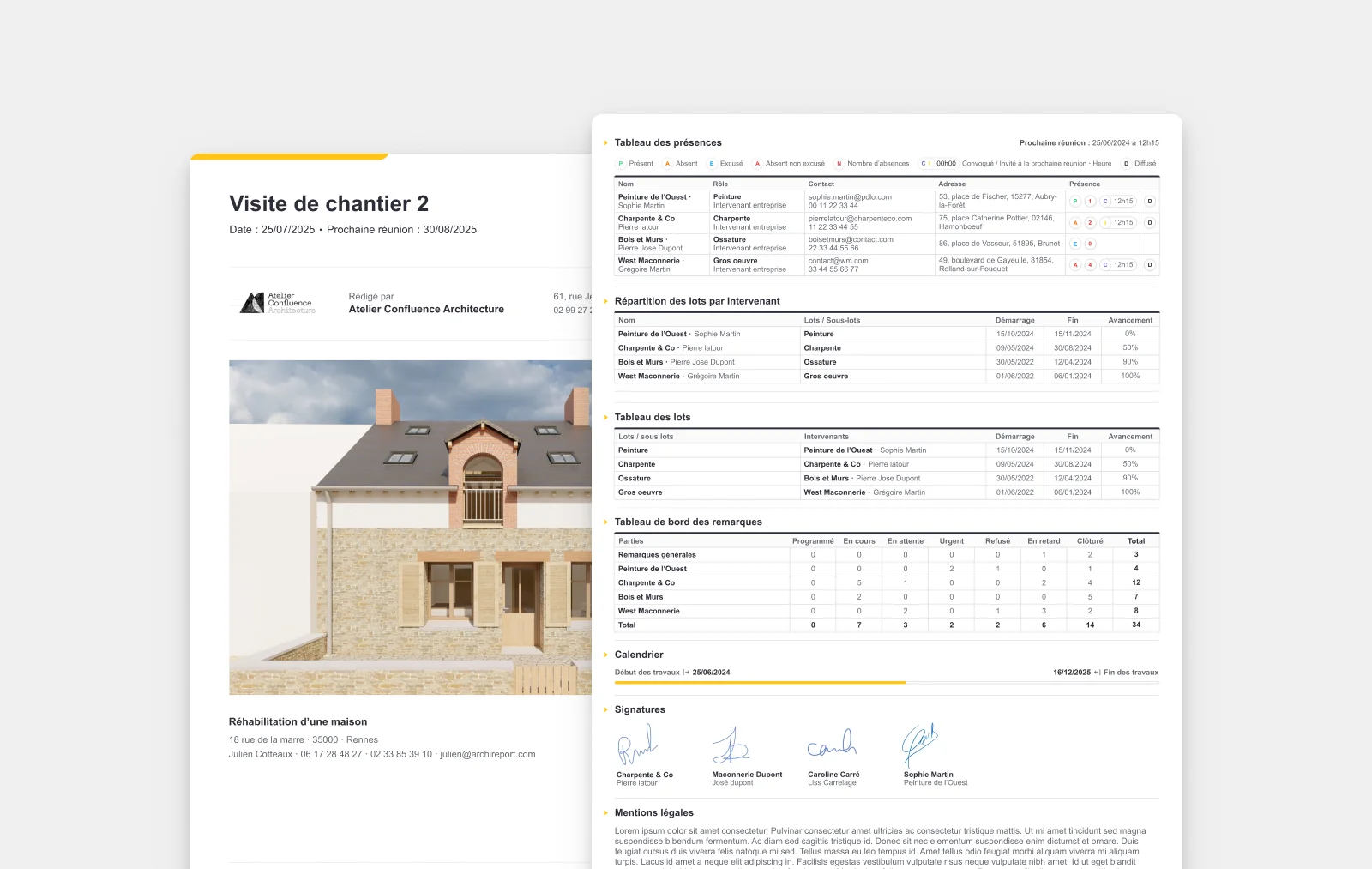
1. The header
The header identifies the document without ambiguity: the name and address of the site, the client, the project manager, the report number, and the date and number of the meeting. It also states the date of the next meeting.
2. The attendance list
The site report lists those present, absent and apologising, as well as the contractors invited. This isn’t a formality: the list holds absentees to account, as they can’t rely on a decision having been taken without them if they were properly invited.
3. The agenda and discussion by trade package
The core of the document follows the agenda, then details the discussion trade package by trade package: progress, observations, blocking points, requests for information. Organising the site report by trade package (structural works, plumbing, electrics…) rather than as one block makes each contractor immediately responsible for what concerns them.
4. Decisions taken
Every decision made in the meeting is clearly recorded. This is what turns a discussion into a commitment: once written down and circulated without challenge, the decision applies to everyone. When a decision commits a contractor (starting a trade package, changing a specification), a written site instruction formalises it.
5. Actions to be taken
For each action, note three inseparable elements: the task, the person responsible and the deadline. An action with no owner and no due date has almost no chance of being carried out. This is the most useful section for genuinely moving the site forward.
6. Deadlines and schedule
A reminder of progress against the planned schedule helps you anticipate slippage. Every delay, and its cause, should be recorded here: it’s the foundation of a site delivered on time.
7. Snags and observations
Snags and technical observations are recorded with their precise location and, ideally, a photo. This is the section that protects you if there is a defect or a dispute.
8. Appendices
Dated and located photos, annotated plans, documents sent: the appendices support and strengthen the site report’s value as evidence.
9. Distribution
The site report ends with the distribution list and a reminder of the period for challenging it. It’s circulating it to everyone that makes the document binding.
Good writing practices
Beyond the structure, the quality of a site report depends on how it is written.

Stick to the facts. A site report describes; it doesn’t judge. “Partition not as per drawing EXE-04, centreline offset by 12 cm” is far better than “sloppy work”. A precise finding is useful and binding; a value judgement is useless and easy to dispute.
Locate and date every finding. An observation is more valuable when it states the trade package and the exact location (level, room, grid line) and is backed up by a photo. Without a location, a snag is hard to clear and weak in a dispute.
Word snags carefully. A snag should describe the defect, refer to the reference document (drawing, specification, technical standard) and say what is expected for it to be cleared. This precision is what makes follow-up possible.
Give every action an owner and a deadline. It’s the golden rule of monitoring: no action without someone in charge and a due date.
Ensure continuity from one meeting to the next. A good site report carries over open actions from previous meetings until they are closed. An observation should never disappear between two site reports.
Send it quickly. Aim for 24 to 48 hours. The faster it goes out, the more the site moves forward and the sooner your decisions are settled.
What format should you use to send the site report?
The reference format remains PDF: it fixes the layout, opens everywhere and archives cleanly. It’s also the simplest format to keep as evidence, since it doesn’t change once sent.
As for sending, an email to the distribution list is enough in most cases, provided you keep a record of it (date and recipients). On the most sensitive sites, some project managers add a signature or a read receipt to secure distribution further. Think about archiving too: a site report you can’t find two years later is worth very little. Ideally, keep all the site reports for a project in one place, numbered and dated, so you can rebuild the full history in a few clicks the day a question comes up.
Finally, take care with photo appendices: a sharp, dated image linked to the right observation often carries more weight in a disagreement than a long paragraph of explanation.
A concrete example: a well-worded snag
To make it concrete, let’s compare two ways of recording the same thing.
Avoid: “Painting problem in the bedroom.” Too vague to be dealt with, impossible to clear properly.
Prefer: “Painting trade package, bedroom 2 (first floor, north wall): colour not matching the approved colour chart (ref. specification, trade package 08). Fix expected by 14/05. Photo no. 7 attached.” Everything is there: the trade package, the location, the defect, the reference, what is expected, the deadline, the evidence. This snag follows itself, and leaves no room for dispute.
The most common mistakes
Some mistakes come up site after site and drain the site report of its substance:
- vague wording that leaves room for interpretation;
- actions with no owner or no deadline;
- snags with no location and no photo;
- open points that disappear from one report to the next;
- a report sent several days after the meeting.
Most of the time, these mistakes don’t come from a lack of seriousness, but from the time it takes to write a complete site report by hand after every visit. That’s exactly where a good tool changes everything.
Writing your site reports with Archireport
Archireport is a chance to win back that time. The idea is simple: you collect everything on site, and the site report almost formats itself.

On site, you take your notes, photograph, annotate with a circle or an arrow, and place each observation directly on the plan. Every snag is dated, located and illustrated during the visit itself, with no re-typing at the office in the evening. You assign an owner and a deadline to each action, and you track snags by contractor with ar.live from week to week, without ever losing one.
The site report is then generated in a clean, professional layout, ready to go to every party in a few seconds. That’s the whole idea behind the Site visit module: you leave the site and your report is already done. The concrete result: fewer phone calls back and forth with tradespeople, clients reassured by clear reports, and evenings that no longer end with writing up notes.
Deep down, that’s also what you’re after: delivering on time, with no nasty surprises, a project you’re proud of. Going from monitoring you endure to monitoring you control, and keeping your eyes on what really matters, the site and its quality, rather than the paperwork.
If you’d like to see what it looks like on your own sites, Archireport is free to try for 30 days, with no commitment and no credit card. Prefer to see it on a case like yours? Book a demo with one of our experts.
In summary
A good site meeting report rests on three pillars: a stable, complete structure, factual and precise writing, and fast, systematic distribution. Under these conditions it fully plays its role as a coordination tool and gains its binding value. And by relying on a tool designed for the field like Archireport, you turn a time-consuming task into a quick habit, for a better-run site and greater peace of mind.
You might also like these modules
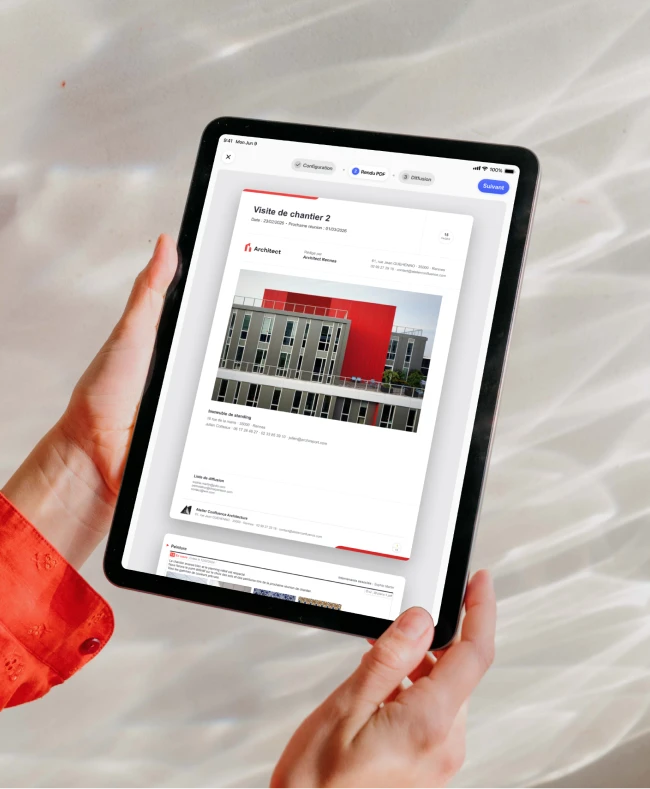
Site visit
Free
Site visit
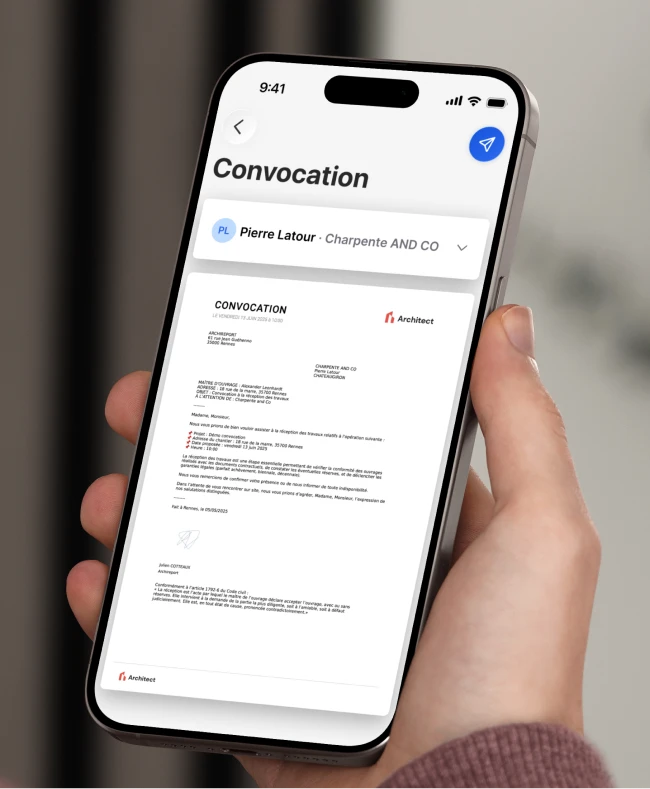
Custom meeting notices
Free
Custom meeting notices
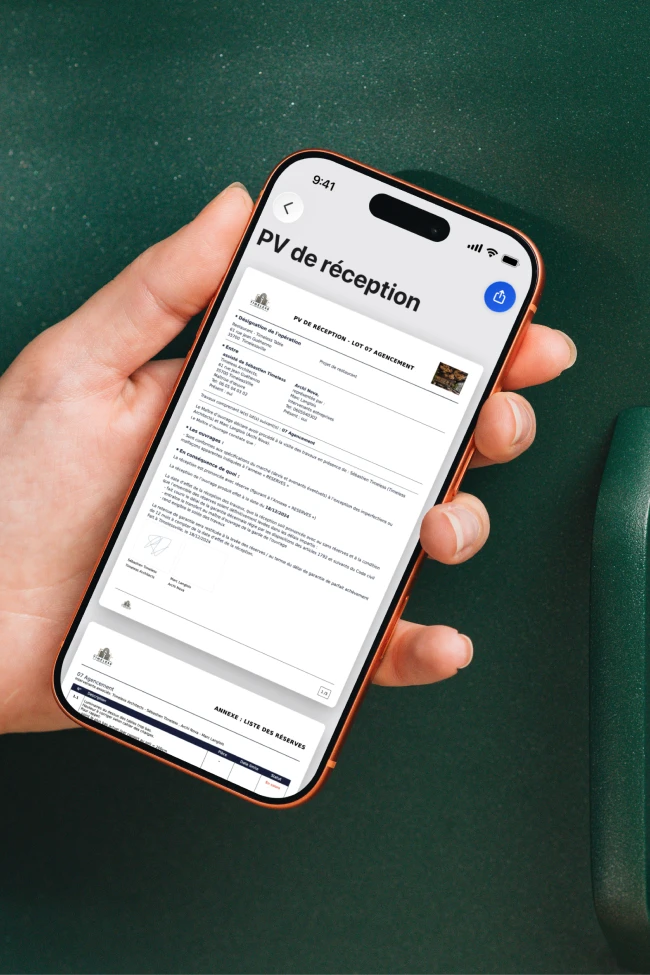
Handover certificate (private contracts)
€5 excl. VAT / month
Handover certificate (private contracts)
Save 60 minutes on your next site visit.

Unlimited projects

Ready to use

No credit card required